


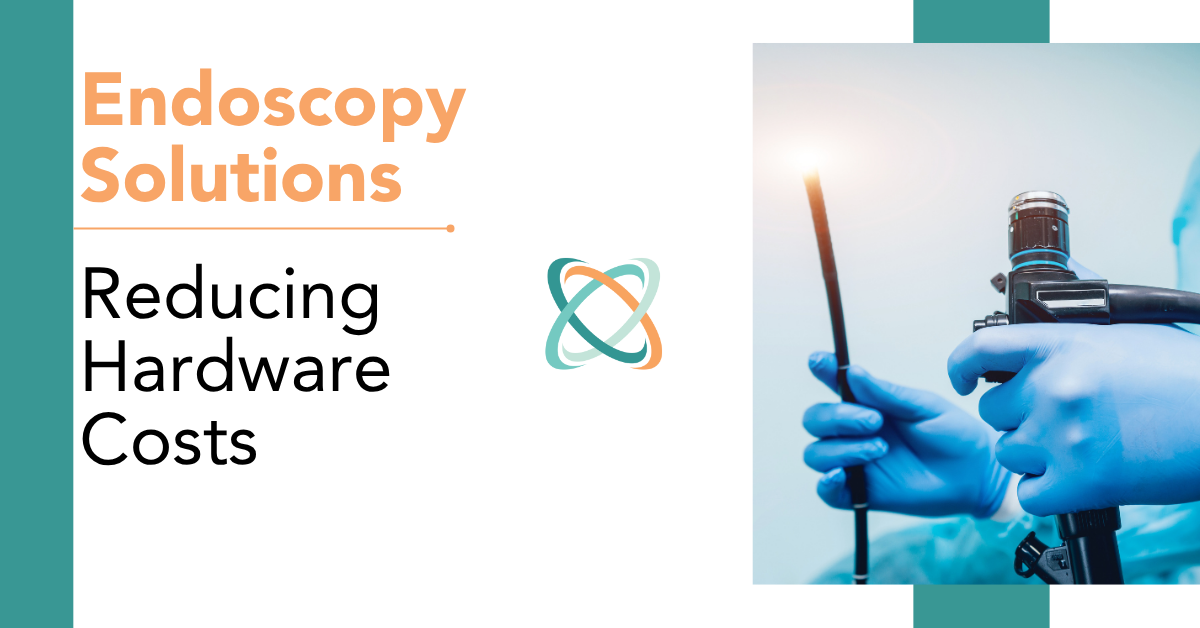
Your endoscopy expansion project started at $200,000 for new rooms and clinical equipment. Then IT presented their technology requirements: capture devices, workstations, and video processors for 12 procedure rooms across three facilities. The project just ballooned to $800,000.
This cost multiplication reflects a fundamental challenge in endoscopy technology deployment. Traditional room-centric hardware models create capital requirements that often exceed the clinical equipment investments they’re meant to support. For health systems managing expansion across multiple facilities, these technology costs can derail strategic growth initiatives or force compromises in patient-care capabilities.
Modern middleware solutions address this challenge by centralizing image management functions on servers rather than deploying dedicated hardware in every procedure room. This architectural approach can reduce technology capital requirements by 60-70% while supporting scalable expansion through existing network infrastructure.
Traditional Hardware Requirements Drive Cost Multiplication
Conventional endoscopy technology architectures require dedicated equipment installations in every procedure room. Each location needs a capture device ($15,000-30,000) to interface cameras with documentation systems, specialized workstations meeting medical device requirements, and video processors for image management.
These per-room requirements create substantial capital multiplication. A 25-room endoscopy program requires $375,000-750,000 in capture device investment before considering workstations or maintenance agreements. Multi-facility health systems face proportional multiplication across every location, often requiring $500,000-800,000 per 10-room facility.
Operational costs compound through distributed hardware support requirements. Each capture device needs desktop management, security patching, and troubleshooting support. Large health systems typically generate 300-500 endoscopy-related IT support requests annually per 40-room deployment, consuming technical resources that could address strategic technology initiatives.
Hardware refresh cycles create additional capital pressure every 3-5 years as devices reach end-of-life. This timing rarely aligns with budget planning cycles, generating unplanned capital requests that compete with clinical equipment investments and facility improvements.
Multi-Site Deployment Challenges
Enterprise health systems face exponential cost scaling when implementing traditional endoscopy solutions across multiple facilities. The per-room hardware model that challenges single-hospital budgets becomes prohibitive when multiplied across 20, 30, or 50+ locations.
Different facilities typically deploy hardware at different times, creating mixed generations of equipment with varying support requirements. IT teams must maintain expertise across multiple hardware platforms while managing disparate maintenance contracts and vendor relationships that prevent enterprise-wide purchasing optimization.
Standardization becomes increasingly difficult as hardware platforms evolve and vendor relationships change. Staff training requirements multiply as each location may operate different equipment, reducing operational efficiency and increasing support complexity.
Server-Hosted Architecture Eliminates Room-Level Hardware
Modern middleware solutions restructure endoscopy technology economics by hosting imaging and documentation functions on central servers accessible through standard network connections. This approach eliminates room-level hardware requirements while improving system reliability and management efficiency.
Direct DICOM camera support removes capture devices by enabling cameras to communicate directly with server-hosted middleware. This eliminates thousands of dollars in per-room hardware while reducing system complexity and failure points. Cameras connect through existing network infrastructure rather than requiring dedicated hardware procurement.
Web-based access transforms workstation requirements from specialized medical computers to standard network terminals. Clinical staff access endoscopy systems through modern web browsers on existing hospital workstations or mobile devices, eliminating dedicated workstation procurement while improving workflow flexibility.
Centralized management consolidates IT overhead from distributed device support to unified system administration. Technical teams maintain one platform serving entire endoscopy networks rather than managing dozens of individual hardware installations.
EndoManager® EMS: Proven Middleware Implementation
NewCura’s EndoManager® EMS demonstrates the cost advantages of strategic middleware architecture. This vendor-neutral, server-hosted solution eliminates traditional hardware multiplication while delivering enterprise-grade capabilities.
The platform supports both direct DICOM and capture-client-based acquisition while integrating with Epic, Oracle Health, and Meditech. This compatibility eliminates vendor lock-in costs while enabling camera selection optimization based on clinical requirements rather than technology constraints.
Centralized image management handles endoscopy and other visible light procedures across all specialties through scalable server capacity rather than hardware multiplication. Adding procedure rooms requires network connectivity and software licensing instead of complete hardware procurement cycles.
Modular design allows health systems to purchase only required functionality. Organizations using Epic Lumens for reporting can exclude redundant modules while maintaining full imaging capabilities. Internal storage integration eliminates expensive VNA requirements while providing comprehensive PACS connectivity and archival functionality.
ScopeCycle® Integration for Compliance Management
ScopeCycle® endoscope tracking complements EndoManager® EMS through cloud-hosted compliance documentation that avoids traditional hardware requirements. Quick deployment processes eliminate lengthy procurement cycles while delivering immediate compliance benefits.
Automated reprocessing workflows guide staff through proper protocols while documenting compliance with manufacturer requirements. This approach eliminates manual documentation systems that create audit vulnerabilities while reducing clinical staff administrative burden.
Financial Impact and Strategic Benefits
Cost analysis reveals substantial savings opportunities when comparing hardware models with middleware solutions. A 35-room endoscopy program deploying traditional capture devices and workstations requires $850,000-1,400,000 in initial hardware investment. Comparable middleware deployment requires $200,000-400,000 in server infrastructure and software licensing, a 60-75% capital reduction.
Operational costs decrease through simplified IT support, consolidated maintenance agreements, and eliminated hardware refresh cycles. Traditional systems generate ongoing expenses averaging $6,000-9,000 per room annually. Middleware solutions typically reduce these costs to $2,000-3,500 per room through centralized management efficiency.
Scalability economics favor middleware architecture as expansion costs remain minimal compared to traditional hardware multiplication And since adding endoscopy capacity through middleware requires only network connectivity and software licensing rather than complete procurement cycles, rapid response to growth opportunities while preserving capital for strategic initiatives becomes possible.
Financial predictability improves when software scaling replaces hardware multiplication in capital planning. Health systems can forecast technology expenses accurately rather than budgeting for unpredictable hardware refresh cycles that compete with clinical equipment investments.
The evidence supports middleware adoption for health systems facing budget constraints and expansion requirements. Traditional hardware-centric endoscopy solutions represent legacy approaches that cannot adapt to modern healthcare economics and operational demands.
Health systems should evaluate cost-effective middleware solutions like EndoManager® EMS that eliminate per-room hardware requirements while reducing total ownership costs. The strategic question is how quickly organizations can transition from expensive legacy models to efficient platforms that preserve capital for patient care investments while delivering superior technological capabilities.


